Ceramic Injection Molding (CIM) represents the fastest-developing and most widely applied precision ceramic manufacturing technology worldwide, combining the design flexibility of polymer injection molding with the superior material properties of advanced ceramic engineering. As a near-net-shape plastic forming method, CIM enables the mass production of small-sized, precise, and complex three-dimensional ceramic components from materials including alumina, zirconia, ZTA, silicon nitride, and silicon carbide. CRAC (Zhuzhou Chuangrui) leverages 28+ years of advanced ceramic expertise to deliver precision injection molded ceramic parts with tolerance accuracy of plus or minus 0.5%, high density, exceptional fracture toughness, and biocompatibility across seven major application fields from medical devices to consumer electronics.
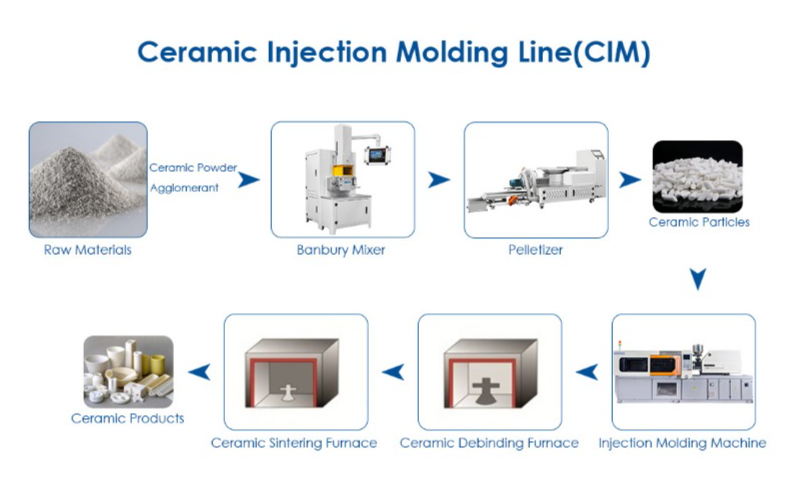
Figure 1: CRAC precision injection molded ceramic parts showcase, demonstrating the design flexibility and dimensional accuracy achievable through the CIM process. Components include ceramic clipper blades, jewelry pieces, watch bezels, capillaries, sleeves, ferrules, medical parts, and cosmetic accessories manufactured from zirconia, alumina, and ZTA materials.
What Is Ceramic Injection Molding (CIM)?
Ceramic Injection Molding (CIM) is a near-net-shape ceramic plastic forming method developed by combining the polymer injection molding technique with ceramic preparation technology. As a branch of modern powder injection molding technology, CIM represents an essential interdisciplinary application that integrates two entirely different processing techniques: plastic injection molding and ceramic sintering technology. This integration liberates product design from the constraints of conventional ceramic forming processes, allowing for the creation of low-cost, intricately shaped parts from a range of advanced ceramic materials in a manner similar to plastic molding.
The fundamental CIM process involves mixing ceramic powder with organic binders to form a feedstock, which is then injection-molded into the desired green part geometry using conventional injection molding equipment. The green part undergoes binder removal (debinding) to extract the organic components, followed by high-temperature sintering to achieve the final dense ceramic component. The result is a precision ceramic part with complex internal and external features that would be difficult or impossible to achieve through conventional machining or pressing methods.
CRAC's CIM capability encompasses the customization of injection molded ceramic parts with different materials, colors, and performance characteristics according to customer requirements. These parts possess characteristics such as biocompatibility, excellent wear resistance, high strength, and a rich variety of colors, serving applications from small household appliances to semiconductor manufacturing, medical treatment, and luxury consumer goods.
Key Advantages of CIM Technology
The CIM process offers three fundamental advantages over conventional ceramic forming methods that make it the preferred manufacturing technology for complex, high-precision ceramic components:
Design Flexibility
CIM enables the design of special-shaped structures both internally and externally, including internal threads, undercuts, side holes, and small apertures that are impossible to achieve through conventional pressing or machining. This design freedom allows engineers to create complex functional geometries without assembly joints or secondary machining operations.
Dimensional Accuracy
Generally, a tolerance accuracy of plus or minus 0.5% can be achieved directly from the molding process. In combination with secondary processing methods such as grinding or lapping, even higher dimensional accuracy can be obtained, meeting the tightest tolerance requirements of precision engineering applications.
Superior Material Properties
CIM-produced parts achieve high density, high strength, high fracture toughness, and high hardness through optimized sintering profiles. The near-net-shape forming process minimizes machining-induced surface defects, resulting in components with superior mechanical performance compared to conventionally machined parts.
Technical Parameters of Injection Molding Ceramic Materials
CRAC's CIM process accommodates a diverse range of advanced ceramic materials, each offering distinct property profiles suited to specific application requirements. The following tables present the key technical parameters for the primary material systems available:
Primary Ceramic Material Systems
| Property |
Alumina (Al2O3) |
Zirconia (ZrO2) |
ZTA |
Silicon Nitride |
Silicon Carbide |
| Density (g/cm3) |
>3.92 |
>6.0 |
>4.0 |
>3.2 |
>3.1 |
| Color |
Ivory |
Ivory/White/Black |
White/Pink |
Gray/Dark |
Black |
| Flexural Strength (MPa) |
>600 |
>1000 |
>700 |
>800 |
>1200 |
| Vickers Hardness (HV) |
2000 |
1200 |
1500-2000 |
1400 |
1800 |
| Elastic Modulus (GPa) |
~200 |
~210 |
~200 |
~200 |
~210 |
| Thermal Conductivity (W/m.K) |
~30 |
~2.5 |
~18 |
~30 |
~120 |
Zirconia Toughened Alumina (ZTA) Variants
| Property |
ZTA Type A |
ZTA Type B |
ZTA Type C |
ZTA Type D |
| Density (g/cm3) |
>4.0 |
>4.25 |
>4.25 |
>4.8 |
| Color |
White |
White |
Pink |
White |
| Flexural Strength (MPa) |
>700 |
>800 |
>800 |
>800 |
| Vickers Hardness (HV) |
2000 |
1800 |
1800 |
1500 |
CIM Manufacturing Process
The CIM process at CRAC integrates multiple precision manufacturing stages, each with dedicated quality control checkpoints. This systematic approach ensures that every injection molded ceramic component meets the stringent dimensional and material property specifications required by high-performance applications.
| Process Stage |
Equipment |
Quality Control Focus |
| 1. Internal Mixing |
Open-close Internal Mixer, Integrated Machine |
Uniform dispersion of ceramic powder in binder system |
| 2. Forming (Injection Molding) |
Precision Injection Molding Machine |
Dimensional accuracy, surface quality, green density |
| 3. Binder Removal |
Chamber Furnace, Pusher Plate Kiln |
Complete binder extraction without structural damage |
| 4. Sintering |
Electric Kiln, Pusher Plate Kiln |
Densification, phase composition, dimensional shrinkage control |
| 5. Precision Machining |
Double End Face Grinding (Height Grinding) |
Final dimensional tolerance, surface flatness, parallelism |
The binder removal stage is particularly critical in the CIM process. CRAC employs both thermal debinding in chamber furnaces and catalytic debinding in pusher plate kilns, depending on the binder system and component geometry. The debinding cycle is carefully controlled to ensure complete removal of organic binders without causing cracking, blistering, or deformation of the fragile brown (partially debound) part. The subsequent sintering process densifies the component to near-theoretical density, with shrinkage of 15-20% from the green dimensions precisely accounted for in the mold design.
Application Fields of CIM Ceramic Parts
CRAC's precision injection molding ceramic parts serve seven major application fields, each exploiting the unique combination of properties offered by advanced ceramic materials and the complex geometry capabilities of the CIM process:
1. Ceramic Clipper Blades
Ceramic clipper blades represent one of the most commercially successful applications of CIM technology. These blades offer high hardness and scratch resistance, high temperature resistance, and acid and alkali corrosion resistance. Most importantly, ceramic blades release no metal ions, making them ideal for personal care applications where skin contact occurs. CIM-produced ceramic clipper blades are widely used in small household appliances such as hair clippers and razors, where their lightweight nature, edge retention, and hypoallergenic properties provide clear advantages over steel alternatives.
2. Ceramic Jewelry Pieces
CIM enables the production of ceramic jewelry with complex geometries and fine surface details that would be impractical to machine from bulk ceramic. These pieces exhibit high hardness, scratch resistance, and corrosion resistance, combined with biocompatibility, oxidation resistance, non-allergenicity, and low susceptibility to bacterial growth. Ceramic accessories are utilized in various fields including earrings, necklaces, bracelets, and supplementary accessories for clothing and luggage. The rich variety of available colors (ivory, white, black, pink) and the ability to create intricate three-dimensional shapes make CIM the ideal manufacturing process for ceramic jewelry.
3. Ceramic Watch Components
In the field of smart wearables and luxury timepieces, CIM-produced ceramic components are applied to back covers, side keys, camera rims, and buttons of mobile phones, as well as watch cases, watch bezels, watch bands, and watch clasps. These components benefit from high hardness and scratch resistance, high temperature and corrosion resistance, strong signal penetration (critical for smartwatch connectivity), rich color options, and smooth tactile feel. The CIM process enables the production of thin-walled, complex-geometry watch components with the precision and surface finish required by luxury consumer goods.
4. Ceramic Capillaries
In the semiconductor field, CIM-produced ceramic capillaries are applied throughout the entire manufacturing process of semiconductors, including the preparation and processing of semiconductor wafers, front-end semiconductor manufacturing, and back-end semiconductor packaging. These components require high strength, wear resistance, corrosion resistance, anti-static properties, and exceptional material purity. The CIM process enables the production of capillaries with precise internal bores and complex external geometries that facilitate automated wire bonding processes.
5. Ceramic Split Sleeves and Ferrules
In the field of optical communication, CIM-produced ceramic split sleeves are applied to the ferrules of conventional fiber optic connectors. These components demand ultra-high dimensional accuracy, high physical strength, excellent wear resistance, and good anti-aging performance. The CIM process achieves the tight tolerances required for fiber optic connector ferrules, where sub-micron dimensional accuracy is essential for maintaining optical signal integrity across connection points.
6. Medical Ceramic Parts
CIM-produced medical ceramic parts include medical filling ceramic pumps and orthodontic components. These parts offer corrosion resistance, wear resistance, low thermal expansion rate (more heat-resistant than metals or plastics), high hardness, high fracture toughness, and good biocompatibility. In medical treatment and orthodontics, ceramic components manufactured through CIM provide the precision, durability, and biocompatibility required for medical device applications, while the CIM process enables the complex internal geometries needed for functional medical components such as pump chambers and valve seats.
7. Ceramic Cosmetic Parts
In the beauty and health preservation field, CIM-produced ceramic parts are applied to cosmetic massage head accessories, ceramic plates for health preservation massage, and similar applications. These components benefit from high hardness, scratch resistance, corrosion resistance, biocompatibility, oxidation resistance, non-allergenicity, low susceptibility to bacterial growth, and no release of metal ions. The CIM process enables the production of smooth, ergonomically shaped massage heads and plates with complex curved surfaces that enhance user comfort and product effectiveness.
Quality Control Management
CRAC's quality control system for injection molded ceramic parts encompasses four management domains, ensuring comprehensive coverage from initial design to final shipment:
Process Design Management
- Determination of technological process according to engineering drawings
- Design of molds, fixtures, and jigs optimized for CIM production
Raw Material Quality Control
- Grain size analysis using laser grain size detectors
- Moisture content measurement via halogen moisture meters
- Bulk density verification using precision balances
- Pressing properties evaluation through pressure testing
- Polymer content determination using precision balances
Production Process Management
Each of the five production stages (internal mixing, injection molding, binder removal, sintering, and precision machining) has dedicated process parameters that are continuously monitored and controlled. Temperature profiles, pressure curves, and cycle times are recorded for every production run, enabling full traceability and process optimization.
Warehouse Inspection Management
- Conventional products: Appearance and dimensional specification inspections
- Specific products: Red dye penetration testing or ultrasonic (UT) non-destructive testing for internal defect detection
CIM vs. Conventional Ceramic Forming Methods
| Comparison Factor |
CIM (Injection Molding) |
Dry Pressing |
Isostatic Pressing |
| Geometry Complexity |
Very high (3D, internal threads, undercuts) |
Low (simple 2D shapes) |
Medium (symmetrical shapes) |
| Dimensional Tolerance |
+/- 0.5% (as-molded) |
+/- 1-2% |
+/- 1-3% |
| Production Volume |
High (mass production) |
High |
Low-Medium |
| Component Size |
Small (typically <100g) |
Small-Large |
Medium-Large |
| Surface Finish |
Excellent (as-molded) |
Requires machining |
Requires machining |
| Tooling Cost |
High (precision molds) |
Low |
Low |
| Per-Part Cost (High Volume) |
Low |
Very Low |
Medium-High |
Frequently Asked Questions
Q: What is the minimum wall thickness achievable with CIM?
A: The CIM process can achieve wall thicknesses as thin as 0.5 mm, depending on the material system and component geometry. Thinner walls may be possible with optimized mold design and process parameters, but practical limits are imposed by the need for complete binder removal and adequate green strength for handling.
Q: Can CIM parts be produced in different colors?
A: Yes, CRAC can customize injection molding ceramic parts with different colors according to customer requirements. Available colors include ivory, white, black, and pink, depending on the material system. Color customization is achieved through careful selection of raw material compositions and dopant additions.
Q: What is the typical production lead time for CIM parts?
A: Lead time depends on whether new mold design and fabrication are required. For existing tooling, production lead time is typically 3-4 weeks. For new projects requiring mold design, fabrication, and process validation, the lead time extends to 8-12 weeks. CRAC's experienced engineering team works closely with customers to optimize the development timeline.
Q: Are CIM-produced ceramic parts suitable for medical applications?
A: Yes, CIM-produced ceramic parts exhibit excellent biocompatibility, corrosion resistance, and wear resistance, making them suitable for medical device applications. CRAC's medical ceramic parts are used in medical filling pumps and orthodontic applications. Material selection (typically high-purity zirconia or alumina) and quality control protocols can be tailored to meet specific medical regulatory requirements.
Ready to Manufacture Complex Ceramic Parts with CIM?
CRAC's Ceramic Injection Molding technology enables mass production of small, precise, and complex three-dimensional ceramic components with +/-0.5% tolerance accuracy. From clipper blades to semiconductor capillaries, we deliver advanced ceramic solutions across seven major industries with 28+ years of manufacturing expertise.
Contact CRAC Technical Team
View Product Catalog