silicon nitride beads (Si3N4) represent the pinnacle of ceramic grinding media technology, engineered for applications where minimal contamination, extreme wear resistance, and energy efficiency are non-negotiable. Unlike conventional zirconia beads, silicon nitride grinding media achieve a wear resistance more than 10 times superior and nearly 20 times greater than high-purity zirconia variants while operating at only 53% of the density. This unique combination of low density, ultra-low abrasion rate (self-abrasion below 1.6 ppm/h), and exceptional hardness positions silicon nitride beads as the grinding medium of choice for semiconductor manufacturing, photovoltaic material processing, high-purity pharmaceutical grinding, and next-generation lithium battery production.
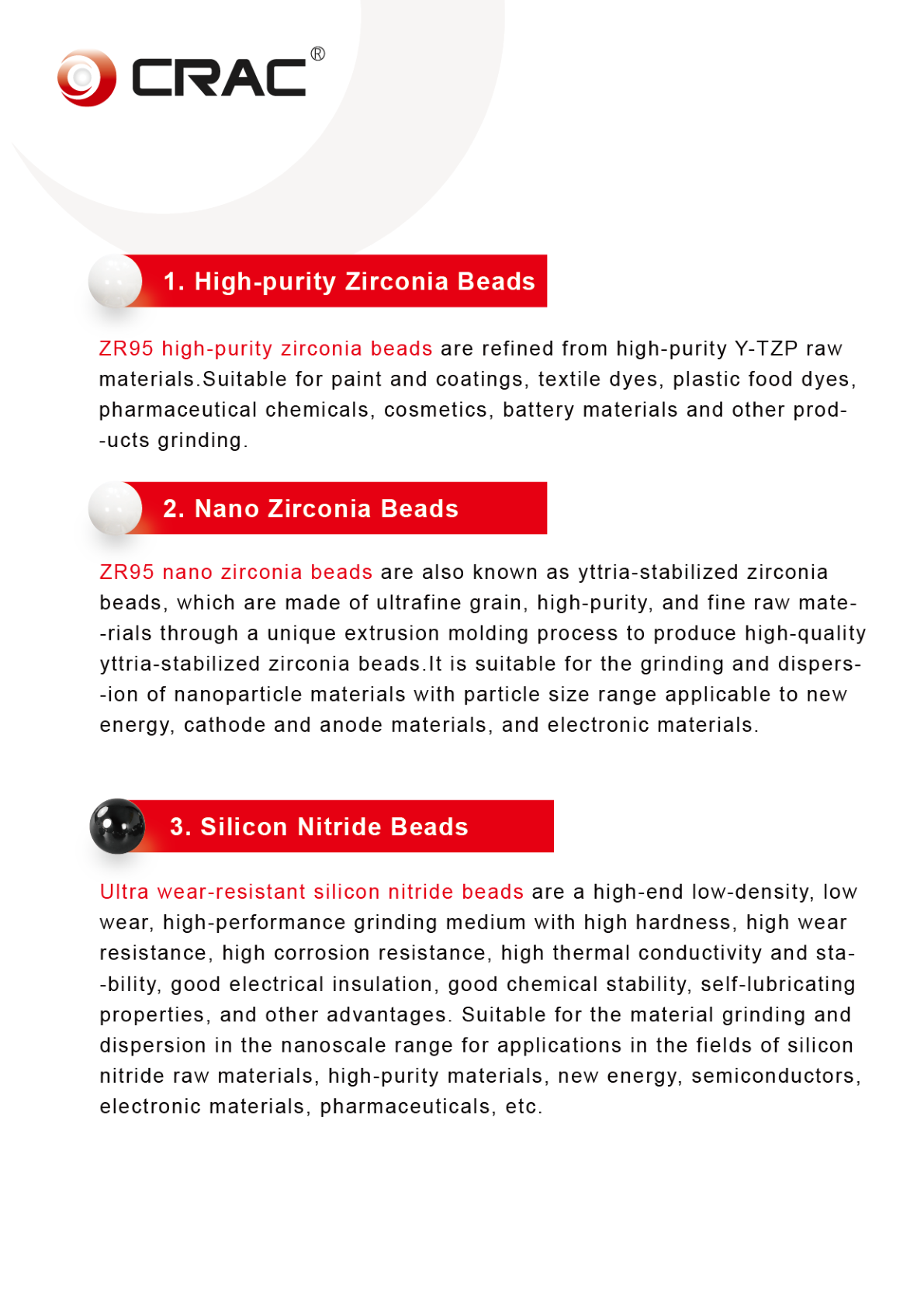
Figure 1: crac silicon nitride beads alongside zirconia grinding media, showcasing the precision spherical geometry, uniform surface finish, and consistent particle size distribution achieved through advanced extrusion molding and vacuum sintering processes.
What Are Silicon Nitride Beads?
Silicon nitride beads are high-performance grinding media manufactured from silicon nitride (Si3N4), an advanced ceramic material renowned for its extraordinary combination of mechanical, thermal, and chemical properties. As a non-oxide ceramic, silicon nitride occupies a privileged position in the materials hierarchy: its hardness is second only to diamond and cubic boron nitride, making it one of the hardest known engineering materials. This exceptional hardness, coupled with intrinsic self-lubricating properties, positions silicon nitride beads as a premium grinding medium for processes demanding the highest levels of purity and efficiency.
CRAC (Zhuzhou Chuangrui High Strength Ceramic Co., Ltd.) produces silicon nitride beads through a proprietary manufacturing process that begins with high-purity silicon nitride powder and employs a unique extrusion molding technique to ensure uniform, dense green bodies. The beads then undergo vacuum sintering to achieve a density of no less than 3.2 g/cm3, followed by a rigorous three-level selection and two-level screening process that guarantees sphericity exceeding 0.97 and tight particle size distribution control. The result is a grinding medium that outperforms zirconia beads in wear resistance by more than 10 times and high-purity zirconia beads by nearly 20 times, while simultaneously reducing energy consumption through its lower density.
The development of silicon nitride beads at CRAC builds on the company's 28+ years of expertise in advanced ceramic manufacturing. Since 1997, when CRAC's chairman Jiang Gui and his team first launched zirconia beads in china, breaking the foreign technological monopoly, the company has continuously expanded its product portfolio to include nano zirconia beads, silicon nitride beads, zirconia ceramic parts, composite ceramic parts, and precision injection molding ceramic parts. Silicon nitride beads represent one of the most technologically advanced products in this lineup, addressing the increasingly stringent purity and efficiency requirements of semiconductor, photovoltaic, and new energy industries.
Technical Parameters of Silicon Nitride Beads
The performance characteristics of CRAC silicon nitride beads are defined by a comprehensive set of technical parameters that collectively determine their suitability for specific grinding applications. The following table presents the key specifications:
Key Technical Specifications
| Parameter |
Specification |
| Size Distribution |
0.1 mm - 3.0 mm |
| Density |
>= 3.2 g/cm3 |
| Average Crushing Strength |
>= 50 Kgf (at 1.0 mm diameter) |
| Sphericity |
> 0.97 |
| Surface Self-Abrasion Rate |
< 1.6 ppm/h |
| Internal Self-Abrasion Rate |
< 1.5 ppm/h |
| Internal Porosity Rate |
< 0.2% |
| Out-of-Tolerance Rate |
<= 0.5% |
The ultra-low self-abrasion rates (surface below 1.6 ppm/h and internal below 1.5 ppm/h) are particularly noteworthy. These figures mean that in a 24-hour continuous grinding operation, the beads lose less than 40 parts per million of their mass through surface and internal wear combined. Such minimal wear translates directly to reduced contamination of the ground product, extended media replacement intervals, and sustained production system stability over long campaign durations.
Ball Diameter Specifications
CRAC offers silicon nitride beads across a comprehensive size range from 0.1 mm to 3.0 mm, with each size category subject to stringent screening and classification protocols. The following table details the diameter specifications for standard sizes:
| Particle Size |
Median Diameter (mm) |
Sphere Diameter Range (mm) |
Max Distribution (mm) |
Max Distribution Ratio |
Out-of-Tolerance Rate |
| 0.1 mm |
0.105 |
0.08-0.12 |
0.09-0.115 |
>50% |
<0.7% |
| 0.2 mm |
0.205 |
0.18-0.23 |
0.185-0.22 |
>50% |
<0.7% |
| 0.3 mm |
0.31 |
0.28-0.33 |
0.295-0.315 |
>55% |
<0.6% |
| 0.4 mm |
0.41 |
0.37-0.43 |
0.39-0.42 |
>55% |
<0.6% |
| 0.5 mm |
0.5 |
0.47-0.53 |
0.48-0.51 |
>55% |
<0.6% |
| 0.6-0.8 mm |
0.6-0.7 / 0.7-0.8 |
0.59-0.82 |
0.58-0.82 |
>60% |
<0.5% |
| 0.8-1.0 mm |
0.8-0.9 / 0.9-1.0 |
0.8-1.0 |
0.79-1.02 |
>60% |
<0.5% |
| 1.0-1.2 mm |
1.0-1.1 / 1.1-1.2 |
1.0-1.2 |
0.99-1.22 |
>60% |
<0.5% |
| 1.2-1.4 mm |
1.2-1.3 / 1.3-1.4 |
1.2-1.4 |
1.19-1.42 |
>60% |
<0.5% |
| 1.4-1.6 mm |
1.4-1.5 / 1.5-1.6 |
1.4-1.6 |
1.38-1.62 |
>60% |
<0.5% |
| 1.6-1.8 mm |
1.6-1.7 / 1.7-1.8 |
1.6-1.8 |
1.58-1.82 |
>60% |
<0.5% |
| 1.8-2.0 mm |
1.8-1.9 / 1.9-2.0 |
1.8-2.0 |
1.77-2.03 |
>60% |
<0.5% |
CRAC can provide products according to customers' specific requirements for particle size distribution and can also deliver optimization solutions for grinding media products based on customers' application areas. This customization capability is particularly valuable for specialized applications where standard size distributions may not deliver optimal grinding performance.
Working Principle of Silicon Nitride Beads
Silicon nitride beads function as the core consumables for grinding micron-sized and nano-sized materials. Their working principle is similar to that of zirconia beads but with significant performance advantages. During equipment operation, the silicon nitride beads rotate at high speed within the grinding cylinder. When the material to be ground is introduced, the particles are gradually broken into smaller fragments under the impact of the high-speed grinding beads, achieving the goal of fine grinding and dispersion.
The grinding efficiency and quality achieved by silicon nitride beads are governed by four fundamental physical properties:
Density and Energy Efficiency
The density of silicon nitride beads is greater than 3.2 g/cm3, which is only 53% of the density of zirconia beads (approximately 6.0 g/cm3). While higher density generally translates to greater kinetic energy and crushing force, the lower density of silicon nitride beads offers a critical advantage: it significantly reduces energy consumption and heat generation during the ultra-fine grinding process. This characteristic is particularly beneficial for temperature-sensitive materials and for reducing the overall operational costs of the milling system. The lower mass of silicon nitride beads also means reduced wear on the contact parts of the grinding equipment, such as the inner cylinder and dispersion discs, extending equipment service life.
Hardness and Impact Resistance
When an impact occurs during the grinding process, only when the grinding medium's hardness is sufficiently high will the material being ground fracture rather than the beads themselves. Silicon nitride beads possess extraordinary hardness, second only to diamond and cubic boron nitride, making them exceptionally high-strength grinding consumables. This extreme hardness ensures that the beads maintain their structural integrity and surface quality even under the most aggressive grinding conditions, preventing bead breakage and the associated contamination of the ground product.
Abrasion and Contamination Control
Silicon nitride grinding beads exhibit an extremely low wear rate, with material loss of only one part per million in 24 hours of continuous operation. Such a minimal level of wear significantly reduces the frequency of media addition and replacement, ensuring stable production system operation. More importantly, the ultra-low abrasion rate dramatically reduces the contamination of the ground material caused by grinding media wear, creating favorable conditions for obtaining high-purity ultra-fine powder. This property is indispensable for applications in semiconductor manufacturing, pharmaceutical processing, and other industries where even trace contamination can compromise product quality.
Wear Resistance and Cost Performance
Silicon nitride beads possess extraordinary wear resistance that is more than 10 times higher than that of standard zirconia beads and nearly 20 times higher than that of high-purity zirconia beads. This dramatic advantage in wear resistance, combined with the lower energy consumption afforded by the reduced density, gives silicon nitride beads a significant cost-performance advantage over alternative grinding media in demanding applications. Despite a higher initial purchase price, the total cost of ownership over the media's extended service life is often substantially lower than that of cheaper alternatives.
Silicon Nitride Beads vs. Zirconia Beads: Comparative Analysis
Understanding the comparative performance of silicon nitride beads versus zirconia beads is essential for selecting the optimal grinding media for a specific application. The following table provides a detailed comparison across key performance metrics:
| Property |
Silicon Nitride Beads |
Zirconia Beads (ZR95) |
| Density |
>= 3.2 g/cm3 |
>= 6.0 g/cm3 |
| Relative Density (% of zirconia) |
53% |
100% (baseline) |
| Wear Resistance |
10x better than zirconia; 20x better than high-purity zirconia |
Baseline reference |
| Self-Abrasion Rate |
Surface <1.6 ppm/h; Internal <1.5 ppm/h |
Significantly higher |
| Sphericity |
> 0.97 |
> 0.98 (nano) / > 0.95 (high-purity) |
| Crushing Strength |
>= 50 Kgf (@1.0 mm) |
>= 10 Kgf (nano) / >= 29 Kgf (high-purity) |
| Energy Consumption |
Lower (reduced heat generation) |
Higher |
| Dispersion Efficiency |
>30% improvement over zirconia |
Baseline |
| Available Sizes |
0.1 - 3.0 mm |
0.05 - 5.0 mm |
| Best Suited For |
High-purity, low-contamination applications |
High-viscosity, high-energy grinding |
Industrial Applications of Silicon Nitride Beads
Silicon nitride beads are commonly used in fields such as silicon nitride powder processing, high-purity material preparation, new energy, photovoltaic materials, and biomedicine. The following sections detail five primary application areas where silicon nitride beads deliver exceptional performance:
1. Silicon Nitride Powder and Raw Material Grinding
Silicon nitride powder is a key raw material for preparing silicon nitride ceramics. To ensure the purity, fineness, and various performance indicators of silicon nitride ceramic products, silicon nitride beads are used for grinding silicon nitride powder and raw materials. Using beads of the same material composition eliminates cross-contamination entirely, as any wear debris from the grinding media is chemically identical to the material being ground. This is a critical advantage for manufacturers of high-performance silicon nitride ceramic components who must maintain strict material purity standards.
2. High-Purity Material Grinding
High-purity materials typically refer to materials requiring extremely low levels of impurities and dopants, such as high-purity metals, oxides, and semiconductor materials. The preparation process of these materials demands the use of high-quality, ultra-wear-resistant silicon nitride beads for material grinding to ensure the purity and stability of the final product. The extremely low abrasion rate of silicon nitride beads (less than 1.6 ppm/h surface wear) means that contamination introduced by media wear is negligible compared to the contamination levels introduced by alternative grinding media.
3. New Energy Lithium Battery Material Grinding
Many high-end battery material manufacturers have adopted silicon nitride beads as a replacement for zirconia beads, achieving significant improvements in the purity, quality, and cost-effectiveness of high value-added powder products. The transition to silicon nitride beads results in more stable lithium battery performance due to the reduced introduction of zirconium contamination into the cathode and anode active materials. This is particularly critical for next-generation battery chemistries where even trace impurities can degrade cycle life, energy density, and safety performance.
4. Photovoltaic Material Grinding
In the production process of photovoltaic modules, silicon nitride grinding balls are widely used for grinding and cutting silicon wafers. Due to their high hardness and exceptional wear resistance, silicon nitride grinding balls can precisely control the thickness and surface quality of silicon wafers, thereby improving the conversion efficiency of photovoltaic modules. The chemical compatibility between the silicon nitride beads and the silicon wafer material also minimizes contamination that could degrade cell efficiency.
5. Biomedical Grinding
The quality of high-purity powders in the biomedical field directly affects the performance and stability of pharmaceutical products. Many manufacturers pursuing pure pharmaceutical grinding to ensure the active ingredients of drugs also use silicon nitride beads. The biocompatibility, chemical inertness, and ultra-low wear rate of silicon nitride make it an ideal grinding medium for preparing active pharmaceutical ingredients (APIs) where contamination with heavy metals or other foreign materials is strictly prohibited. Silicon nitride beads can be sterilized by high-pressure sterilization without changing their mechanical properties, making them suitable for aseptic pharmaceutical manufacturing environments.
Quality Control Management
CRAC maintains a comprehensive quality control system for silicon nitride beads that spans the entire production lifecycle from raw material inspection to final shipment. This multi-stage approach ensures consistent product quality and performance across every production batch.
Raw Material Quality Control
Every incoming batch of silicon nitride raw material undergoes rigorous testing including:
- Chemical Composition analysis via X-ray Fluorescence (XRF) spectrometry
- Crystalline Phase identification through X-ray Diffraction (XRD)
- Particle Size Distribution (PSD) measurement using laser diffraction
- Specific Surface Area determination via Brunauer-Emmett-Teller (BET) analysis
- Moisture Content verification using Loss-on-Drying (LOD) methods
- Apparent Density assessment by bulk density measurement
Production Process Control
The production process for silicon nitride beads involves five critical stages, each with dedicated quality control checkpoints:
| Process Stage |
Quality Control Measures |
| 1. Forming Process |
Chemical composition (XRF), particle size distribution (PSD), specific surface area (BET), viscosity (rheometer), moisture content (LOD) |
| 2. Vacuum Sintering |
Sintering curve monitoring, compressive strength testing, internal structure inspection |
| 3. Polishing Process |
Surface finish measurement, apparent density verification |
| 4. Selection Process |
Sphericity measurement, alien ball rate assessment |
| 5. Screening Process |
Particle size distribution verification, particle size deviation rate control |
Shipment Inspection
Before any batch of silicon nitride beads is released for shipment, it undergoes a comprehensive final inspection protocol that includes:
- Particle size distribution verification
- Internal structure integrity inspection
- Density measurement (bulk density by drainage method, packing density by stacking method)
- Compressive strength testing
- Surface finish assessment
- Vickers Hardness (HV) verification
Manufacturing Process of Silicon Nitride Beads
The manufacturing process for CRAC silicon nitride beads incorporates several proprietary technologies that distinguish the final product from competing grinding media:
Extrusion Molding: CRAC employs a unique extrusion molding process that produces green bodies with exceptional uniformity and density. This process ensures that the beads have consistent mechanical properties throughout their volume, eliminating the weak points and density gradients that can lead to premature bead failure in service.
Vacuum Sintering: The green bodies undergo vacuum sintering to achieve a final density of no less than 3.2 g/cm3. The vacuum environment prevents oxidation of the silicon nitride during the high-temperature sintering process and ensures the formation of a dense, pore-free microstructure. The internal porosity rate of the finished beads is maintained below 0.2%, a critical parameter for achieving the ultra-low wear rates that distinguish silicon nitride beads from other grinding media.
Three-Level Selection and Two-Level Screening: After sintering, the beads are subjected to a rigorous classification process. The three-level selection process removes beads that do not meet the sphericity standard (>0.97), while the two-level screening process ensures tight particle size distribution control with out-of-tolerance rates below 0.5% for larger sizes and below 0.7% for the smallest sizes.
Ultra-High Speed Pre-Grinding: All beads undergo an ultra-high speed pre-grinding process before shipment. This step ensures that no beads will break during actual use, as any beads with latent defects are identified and removed during this aggressive pre-conditioning phase.
Selection Guide: When to Choose Silicon Nitride Beads
Selecting the appropriate grinding media for a specific application requires careful consideration of multiple factors. The following guidelines help determine when silicon nitride beads represent the optimal choice:
Choose Silicon Nitride Beads When:
- The ground product requires ultra-high purity with contamination levels measured in parts per million
- The application involves semiconductor, photovoltaic, or pharmaceutical materials where trace metal contamination is unacceptable
- Extended production campaigns require minimal media replacement frequency to maintain system stability
- Temperature-sensitive materials benefit from reduced heat generation during grinding
- The grinding system's contact components (cylinder walls, dispersion discs) are susceptible to wear from high-density media
- The total cost of ownership over the media's service life is more important than the initial purchase price
- Ultra-fine dispersion efficiency improvements of 30% or more are desired over zirconia bead performance
Consider Zirconia Beads When:
- The application involves high-viscosity pastes that require the greater kinetic energy of higher-density media
- Contamination tolerance is less stringent and cost per kilogram of grinding media is the primary concern
- The material being ground is not chemically compatible with silicon nitride
- Bead sizes smaller than 0.1 mm or larger than 3.0 mm are required (beyond the silicon nitride size range)
Frequently Asked Questions
Q: Why are silicon nitride beads more expensive than zirconia beads?
A: Silicon nitride beads require more sophisticated raw materials, a vacuum sintering process, and tighter quality control protocols than zirconia beads. However, their wear resistance is 10-20 times superior, meaning they last significantly longer and introduce far less contamination. In high-purity applications, the total cost of ownership including reduced downtime, lower replacement frequency, and eliminated contamination-related product losses often favors silicon nitride beads despite the higher initial cost.
Q: Can silicon nitride beads be used in all types of grinding equipment?
A: Silicon nitride beads are compatible with most grinding equipment including horizontal bead mills, vertical bead mills, planetary ball mills, and agitator mills. Their lower density (53% of zirconia) may require adjustment of operating parameters such as tip speed and filling ratio to optimize grinding performance. CRAC can provide optimization solutions tailored to specific equipment configurations.
Q: How does the lower density of silicon nitride beads affect grinding efficiency?
A: While lower density means less kinetic energy per bead, silicon nitride beads achieve a higher actual linear velocity during operation, which enhances ultra-fine dispersion efficiency by more than 30% compared to zirconia beads. The reduced mass also decreases energy consumption and heat generation, which is beneficial for temperature-sensitive materials and reduces cooling requirements.
Q: What customization options are available for silicon nitride beads?
A: CRAC can customize non-standard grinding media according to customers' specific needs, including tailored particle size distributions, specialized size ranges, and optimization solutions based on the customer's application area and equipment configuration. Contact CRAC's technical team to discuss your specific requirements.
Ready to Upgrade Your Grinding Performance?
CRAC's silicon nitride beads deliver 10-20x better wear resistance, 30% higher dispersion efficiency, and unmatched purity protection for your most demanding grinding applications. With 28+ years of advanced ceramic expertise, we provide customized solutions for semiconductor, photovoltaic, new energy, and pharmaceutical industries.
Contact CRAC Technical Team
View Product Specifications