A zirconia ceramic ball milling jar is a critical component in planetary ball mills, roller ball mills, and stirred media mills used for high-purity grinding, mechanical alloying, and nano-scale powder synthesis. Unlike traditional grinding containers made of stainless steel, agate, or alumina, zirconia jars deliver zero metal contamination, exceptional wear resistance (10-20× longer service life), and chemical inertness that preserves the integrity of sensitive materials across industries including lithium battery production, pharmaceutical API grinding, advanced ceramics R&D, and semiconductor powder processing. CRAC (Zhuzhou Chuangrui) manufactures yttria-stabilized zirconia (Y-TZP) ceramic ball milling jars with precision-ground interior surfaces achieving Ra 0.1 roughness, cylindricity within 0.005 mm, and tight-sealing lid mechanisms that eliminate material leakage and grinding dead zones for reproducible, contamination-free milling outcomes.

Figure 1: CRAC yttria-stabilized zirconia (Y-TZP) ceramic ball milling jar featuring a large arc-angle interior profile and precision-engineered sealing lid — the optimal choice for planetary ball mill applications requiring zero contamination and extended service life.
Why Zirconia Outperforms Traditional Ball Mill Jar Materials
The choice of jar material directly determines grinding efficiency, contamination risk, and equipment longevity. Traditional materials each carry inherent limitations that become critical failure points under demanding milling conditions. Selecting the wrong material can introduce parts-per-million (ppm) contamination that renders an entire batch of high-value material unusable — a risk that industries processing battery-grade materials or pharmaceutical intermediates cannot afford.
Stainless steel jars are the most common entry-level choice, but they release iron, chromium, and nickel ions into the ground product — catastrophic for applications requiring ppm-level purity. Under prolonged wet milling with acidic or alkaline slurries, stainless steel undergoes galvanic corrosion that accelerates contamination and roughens interior surfaces, reducing milling efficiency.
Agate jars (natural chalcedony quartz) offer better chemical resistance than metal but suffer from low fracture toughness (~1 MPa.m1/2). Even minor impact from high-density grinding media can cause micro-cracking and catastrophic jar failure. Agate's maximum hardness of ~7 Mohs limits its use to soft and medium-hard materials only.
Alumina (Al2O3) jars are the most common ceramic alternative, with 99.5%+ purity, hardness of ~15 GPa, and reasonable cost. However, alumina's fracture toughness of 3-4 MPa.m1/2 is significantly lower than zirconia's, and its wear rate under high-energy milling with dense grinding media (zirconia beads) is 5-10× higher. The aluminum contamination introduced, while lower than metal, can still interfere with sensitive chemical reactions and material properties.
Tungsten carbide jars deliver extreme hardness (~24 GPa) but introduce tungsten and cobalt contamination, carry prohibitive cost, and exhibit poor corrosion resistance in acidic environments — a fatal limitation for many chemical and pharmaceutical applications.
Yttria-stabilized zirconia (Y-TZP) jars overcome all these limitations simultaneously. With hardness exceeding 12 GPa, fracture toughness of 8-10 MPa.m1/2, density of ~6.05 g/cm³, and near-zero chemical reactivity across the full pH spectrum, zirconia jars are uniquely positioned as the universal solution for high-purity, high-energy milling. The transformation toughening mechanism inherent to Y-TZP — where stress-induced tetragonal-to-monoclinic phase transformation at crack tips generates compressive stress that arrests propagation — gives zirconia an effective service life 10-20 times longer than alumina jars under identical milling conditions.
| Material |
Hardness (GPa) |
Fracture Toughness (MPa.m1/2) |
Density (g/cm³) |
Contamination Risk |
Relative Wear Life |
| Y-TZP Zirconia |
12-13 |
8-10 |
6.05 |
Near Zero |
★★★★★ |
| 99.5% Alumina |
15-16 |
3-4 |
3.92 |
Low-Moderate |
★☆☆☆☆ |
| Stainless Steel 316L |
~2 |
>50 |
8.0 |
High (Fe, Cr, Ni) |
★☆☆☆☆ |
| Agate (SiO₂) |
~7 Mohs |
~1 |
2.65 |
Near Zero |
★☆☆☆☆ |
| Tungsten Carbide |
22-24 |
6-8 |
15.6 |
High (W, Co) |
★★★★☆ |
Table 1: Comprehensive comparison of ball milling jar materials, highlighting zirconia's unique combination of high hardness, superior fracture toughness, and zero contamination.
Zirconia Material Grades for Ball Milling Jars
CRAC produces ceramic ball milling jars across multiple zirconia material grades, each engineered for specific grinding environments and performance requirements:
1. Y-TZP (3Y Series) — The Universal Standard
3 mol% yttria-stabilized tetragonal zirconia polycrystal (3Y-TZP) is the industry-standard material for ceramic ball milling jars. The 3 mol% yttria doping stabilizes the tetragonal phase at room temperature, enabling the transformation toughening mechanism that delivers fracture toughness of 8-10 MPa.m1/2 — the highest among all oxide ceramics. This grade achieves an optimal balance of hardness (≥12 GPa), bending strength (>1000 MPa), and wear resistance, making it suitable for wet and dry grinding of hard, abrasive materials including ceramic powders, mineral ores, and battery electrode precursors.
CRAC's 3Y-TZP ball milling jars undergo a rigorous post-sintering precision grinding process that brings interior surface roughness down to Ra 0.05-0.1, minimizing material adhesion and ensuring consistent particle size reduction across milling campaigns. After grinding in a roller ball mill for 48 hours with 40-mesh corundum sand abrasive, CRAC's zirconia jar surfaces show no visible change — a testament to the exceptional wear resistance of properly densified Y-TZP ceramics.
2. A-ZR (Y8 Series) — Optimized for Dry Grinding
The Y8 composite stabilized zirconia series is independently developed by CRAC and specifically optimized for dry grinding applications. Its composite stabilization mechanism — incorporating multiple stabilizing oxides beyond yttria alone — provides enhanced thermal shock resistance and reduced wear under the high-friction, high-temperature conditions characteristic of dry milling. For applications where cooling liquids cannot be used due to material sensitivity or process constraints, Y8 series jars maintain structural integrity and dimensional stability that single-stabilized zirconia cannot match over extended dry grinding campaigns.
3. PR-ZR (Yellow Zirconia) — Application-Specific Variant
CRAC's yellow yttria-stabilized zirconia series offers mechanical and chemical performance identical to standard white Y-TZP, with the distinctive coloration arising from raw material processing conditions rather than compositional differences. It is important to note that CRAC's yellow zirconia is not the magnesium-stabilized (Mg-PSZ) variant commonly found on the market — it maintains the full transformation toughening capability and wear resistance of yttria-stabilized zirconia, making it suitable for applications where color-coding or visual differentiation between jar types is desired in multi-jar laboratory workflows.
4. Composite Ceramic Jars — Enhanced Toughness
For extreme-duty applications involving impact-prone milling conditions, CRAC offers composite ceramic ball milling jars where polymer materials are infiltrated into the ceramic grain boundary network using a proprietary process. This grain-boundary engineering approach significantly enhances fracture toughness beyond the levels achievable with monolithic ceramics, arresting crack propagation through polymer bridging mechanisms while maintaining the excellent wear and corrosion resistance of the ceramic matrix. These composite jars represent the frontier of ball milling jar technology for applications where catastrophic failure due to mechanical shock is the primary failure mode.

Figure 2: CRAC zirconia ceramic ball milling jar product range, demonstrating the graduated dimensional options available — from 50 mL laboratory-scale jars to multi-liter industrial production vessels, all featuring the same precision-ground interior surfaces and tight-sealing lid geometry.
Design Features That Maximize Grinding Performance
A ceramic ball milling jar is far more than a simple cylindrical container — its geometry, seal design, and interior surface finish collectively determine grinding efficiency, batch-to-batch reproducibility, and operational safety. CRAC's ball milling jars incorporate several design innovations derived from decades of collaboration with end users across laboratory and industrial settings:
Large Arc-Angle Interior Profile
The interior geometry of CRAC's ceramic ball milling jars features an optimized large arc-angle profile at the jar bottom and wall junction. This design eliminates the sharp 90° corner transitions found in conventional jars, where material can compact into inaccessible dead zones and escape the grinding action entirely. The smooth radius transition ensures that grinding media maintains continuous tumbling and cascading motion throughout the entire jar volume, maximizing the effective working capacity and producing narrower particle size distributions. For planetary ball mills operating at high rotational speeds (up to 800 rpm), this arc-angle optimization becomes critical — sharp corners in traditional jars create turbulence zones that dissipate kinetic energy and reduce milling efficiency.
Precision Sealing System
The sealing performance of the jar lid directly determines whether ultra-fine powders escape during milling — a significant safety concern when processing toxic, reactive, or high-value materials. CRAC's lid design employs a precision-ground ceramic-to-ceramic or ceramic-to-PTFE sealing interface, with optional O-ring gasket channels for applications requiring hermetic sealing under vacuum or inert gas atmospheres. The clamping mechanism distributes force evenly across the sealing surface, preventing the localized stress concentrations that cause lid cracking in lower-quality jars. This seal integrity is maintained even after hundreds of milling cycles and repeated autoclave sterilization — a critical requirement for pharmaceutical and biomedical applications.
Interior Surface Finish (Ra 0.05-0.1)
Post-sintering diamond grinding brings the interior surface of CRAC zirconia jars to an ultra-smooth finish of Ra 0.05-0.1 — approaching optical-grade polish. This surface quality serves three purposes: it minimizes the adhesion of fine powders to jar walls that would reduce yield and complicate cleaning between batches; it reduces the effective surface area available for chemical reactions between the jar material and aggressive milling media or slurries; and it provides a consistent baseline surface condition that ensures batch-to-batch grinding reproducibility. For applications processing nano-scale powders (<100 nm target particle size), the surface finish of the jar interior directly affects the lower limit of achievable particle size reduction.
Ceramic-Metal Bonding Capability
For applications where ceramic jars must interface with metallic drive components, mounting brackets, or temperature-control jackets, CRAC provides ceramic-to-metal bonding services using epoxy resin or specialized ceramic adhesive bonding methods. This capability enables the integration of zirconia's exceptional grinding performance with the structural mounting requirements of industrial-scale milling equipment, without compromising the contamination-free nature of the ceramic grinding environment.

Figure 3: Interior view of a CRAC zirconia ceramic ball milling jar with the precision-ground surface (Ra 0.05-0.1) and the large arc-angle profile clearly visible. The smooth radius transition at the jar bottom eliminates grinding dead zones, ensuring uniform media motion and consistent particle size reduction throughout the entire load volume.
Standard Size Range and Customization Capabilities
CRAC's advanced ceramic machining capabilities enable the production of ball milling jars spanning a wide dimensional range, from compact 50 mL jars for laboratory research to multi-liter vessels for pilot-scale and production milling. The company's processing precision limits — inherited from its broader structural ceramics manufacturing platform — ensure that every jar, regardless of size, meets the same exacting dimensional tolerances:
| Dimensional Parameter |
Processing Limit |
Notes |
| Maximum Outer Diameter |
600 mm |
Suitable for production-scale vessels |
| Maximum Inner Diameter |
500 mm |
Capacity proportional to ID cubed |
| Maximum Tube Height |
500 mm |
L/D ratio customizable per application |
| Inner Diameter Accuracy |
0.02 mm |
± tolerance on specified diameter |
| Outer Diameter Accuracy |
0.016 mm |
Critical for mounting interface fit |
| Cylindricity |
0.005 mm |
Ensures uniform wall thickness |
| Interior Surface Roughness |
Ra 0.05-0.1 |
Diamond-ground finish |
| Parallelism (Lid Seating) |
0.01 mm |
Critical for seal integrity |
Table 2: Dimensional accuracy and processing precision specifications for CRAC zirconia ceramic ball milling jars. All tolerances are independently verified against GB/T, ASTM, and JIS standards.
Beyond standard cylindrical geometries, CRAC's machining capabilities extend to custom jar configurations including flat-bottom designs for roller mills, conical-bottom jars for complete discharge, multi-chamber vessels for sequential grinding, and jars with integrated temperature-control jackets or sampling ports. The company's component-level grinding capacity accommodates inner diameter grinding for jars with ID >200 mm to depths of 1000 mm, ID 155-200 mm to depths of 500 mm, and ID 30-150 mm to depths of 200 mm — spanning the full range from R&D sample preparation to pilot production volumes.
Pairing Ball Milling Jars with the Right Grinding Media
The performance of a ceramic ball milling jar cannot be evaluated in isolation — it is the jar-media-material system that determines grinding outcomes. Mismatching jar and media materials can negate the very contamination-free advantage that motivated the selection of zirconia in the first place. When both jar and media are zirconia-based, the system achieves thermodynamic compatibility where no galvanic potential exists and wear particles are chemically identical to the desired grinding surfaces.
Yttria-stabilized zirconia beads (Y-TZP) are the ideal pairing for Y-TZP jars. With density of ~6.05 g/cm³, hardness of ~12 GPa, and self-wear rates as low as 1.6 ppm/hour, zirconia beads maximize the kinetic energy transferred to the material being ground while minimizing cross-contamination. For ultra-high-purity applications such as pharmaceutical API micronization or battery cathode material processing, the all-zirconia jar-bead system ensures that the only wear debris introduced is chemically identical to the jar material — preventing the multi-element contamination fingerprint that plagues mixed-material systems.
Silicon nitride (Si3N4) beads offer an alternative pairing that can outperform zirconia-on-zirconia in specific applications. With density of ~3.23 g/cm³ (53% lighter), hardness of ~15 GPa (25% harder), and fracture toughness exceeding 7 MPa.m1/2, silicon nitride beads paired with zirconia jars deliver 10-20× lower jar wear rates compared to zirconia bead-zirconia jar systems. The lower bead density is advantageous for gentle dispersion applications where excessive impact energy would damage sensitive particles. However, the dissimilar material pairing introduces silicon and nitrogen into the wear debris stream — acceptable for most industrial applications but requiring careful evaluation for semiconductor-grade or biomedical materials.
Media size selection follows the principle that bead diameter should be approximately 20-30× the target particle size of the ground product. For nano-scale grinding targeting D50 <100 nm, bead diameters of 0.1-0.3 mm are typically specified; for micron-scale grinding targeting D50 of 1-10 µm, bead diameters of 0.5-1.0 mm provide the optimal balance of impact energy and surface area. CRAC provides grinding media in diameters from 0.1 mm to 3.0 mm, with ≤0.01 mm tolerance on specified diameter and sphericity exceeding 0.97 — enabling precise media selection matched to each application's particle size reduction requirements.
Applications Across Industries
New Energy — Lithium Battery Materials
The production of high-performance lithium-ion battery cathode materials (NMC, LFP, LCO) and anode materials (silicon-carbon composites) demands grinding systems that introduce absolutely zero metal contamination. Even parts-per-billion levels of iron, chromium, or nickel can nucleate internal short circuits or catalyze undesirable side reactions during charge-discharge cycling. Advanced ball mills equipped with zirconia grinding beads operating inside Y-TZP zirconia jars provide a completely metal-free grinding environment, enabling battery manufacturers to achieve target particle sizes of 1-5 µm for cathode materials and sub-micron sizes for next-generation solid-state electrolyte precursors — all without the contamination penalty that would disqualify the material from downstream cell assembly.
Pharmaceutical and Biomedical Grinding
Active pharmaceutical ingredient (API) micronization and bioavailability enhancement through particle size reduction represent some of the most contamination-sensitive grinding applications in existence. Zirconia ceramic ball milling jars, when paired with high-purity ceramic components, enable the preparation of drug nanoparticles in stirred media mills without the metal ion leaching that would trigger regulatory rejection during USP <232>/<233> elemental impurity testing. The biocompatibility of properly processed Y-TZP — a material already used in hip implant femoral heads and dental restorations — means that even in the unlikely event of microscopic wear debris, the introduced material poses no toxicological risk. CRAC's high-performance nano ceramic microbeads, when used in conjunction with zirconia jars in stirred ball mills or centrifuges, deliver the lowest possible wear during active ingredient preparation and cell disruption protocols.
Advanced Ceramics Research and Development
Academic and industrial laboratories developing next-generation ceramic materials — including transparent ceramics for laser gain media, high-entropy ceramic composites, and MAX phase ternary carbides — require ball milling jars that do not cross-contaminate experimental compositions. A single milling run in a contaminated jar can introduce foreign elements that alter sintering behavior, phase evolution, and final material properties, invalidating months of research. Zirconia jars eliminate this variable, providing a chemically inert grinding environment that preserves the compositional integrity of experimental ceramic powder formulations from synthesis through characterization.
High-Purity Mineral and Pigment Processing
The production of high-whiteness mineral fillers (calcium carbonate, talc, kaolin), titanium dioxide pigments, and cosmetic-grade powders imposes strict color and purity specifications that metal or alumina contamination would compromise. Zirconia jars maintain optical whiteness and chemical neutrality throughout extended grinding campaigns, ensuring that the ground product meets the demanding colorimetry and heavy-metal limits required by paper, paint, plastics, and personal care product manufacturers.
Manufacturing Quality and Material Certification
CRAC's ceramic ball milling jars are produced within an ISO 9001-certified quality management system that traces every jar from raw powder through final inspection:
Raw material control. Zirconia powders are sourced from qualified suppliers with certificates of analysis verifying chemical composition, particle size distribution, and phase purity. Incoming powder lots are tested against GB/T 21114 (oxide reference materials for XRF analysis) before release to production.
Green body forming. Jar blanks are produced through isostatic pressing or slip casting, with green density verified against established process control limits to ensure uniform densification during subsequent sintering.
Sintering. Multiple high-temperature sintering furnaces operating under precisely controlled atmosphere and thermal profiles achieve >99.5% theoretical density, verified by Archimedes method per GB/T 25995. The sintering process is the critical step that determines final grain size, phase composition, and mechanical properties — CRAC's decades of sintering expertise ensures jar-to-jar consistency.
Precision machining. Post-sintering diamond grinding on CNC equipment achieves the dimensional tolerances and surface finishes documented above. Every jar is measured against its dimensional specification using calibrated metrology equipment, with inspection data retained for traceability.
Final inspection. Each jar undergoes visual inspection for surface defects, dimensional verification against drawing specifications, and — for critical applications — dye penetrant testing to verify the absence of surface-connected porosity that could harbor contamination between batches. Material certification documents including chemical composition, density, hardness, and flexural strength are available upon request.
.png)
Figure 4: CRAC zirconia ceramic ball milling jar with PTFE sealing gasket and stainless steel clamping lid assembly, designed for contamination-free wet or dry grinding in planetary ball mills and roller mills.
.png)
Figure 5: CRAC zirconia ceramic ball milling jar demonstrating the large arc-angle interior profile, uniform wall thickness, and precision-ground surfaces that ensure consistent grinding performance across extended milling campaigns.
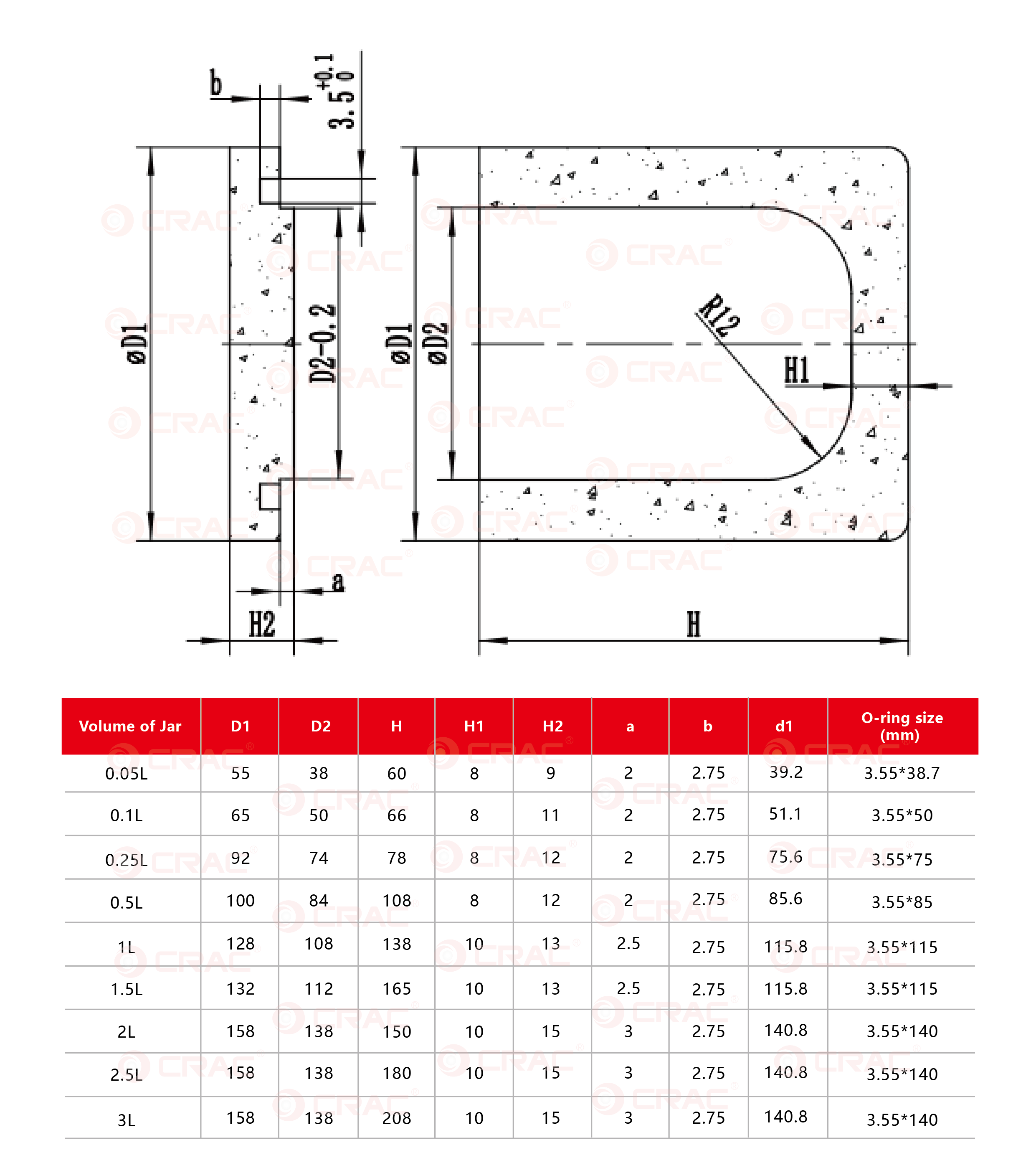
Figure 6: Dimensional drawing showing the standard size range and key measurement parameters for CRAC zirconia ceramic ball milling jars, including outer diameter, inner diameter, height, and wall thickness specifications.
Selecting the Right Zirconia Ball Milling Jar for Your Application
Choosing the optimal zirconia ceramic ball milling jar requires evaluating the following factors:
1. Mill compatibility. Verify the jar's outer dimensions, clamping mechanism, and drive interface match your specific mill model. Planetary ball mills typically use jars with capacities of 50-500 mL per station, while roller mills accommodate larger cylindrical jars. Providing your mill make and model enables CRAC to confirm dimensional compatibility.
2. Material to be ground. The hardness, abrasiveness, and chemical nature of your material determine the optimal jar material grade. For general-purpose wet grinding of hard ceramics and minerals, standard 3Y-TZP is recommended. For extended dry grinding, the Y8 composite stabilized series offers superior thermal shock resistance. For chemically aggressive environments, composite ceramic jars provide enhanced durability.
3. Grinding media selection. The jar must be paired with grinding media of appropriate material, size, and fill ratio. For contamination-sensitive applications, matching Y-TZP media with Y-TZP jars is the safest approach. For maximum jar life with moderate contamination tolerance, silicon nitride media offers the best combination of hardness and low wear.
4. Atmosphere requirements. If milling must be performed under vacuum or inert gas (argon, nitrogen), specify the required sealing configuration. CRAC can provide jars with integrated gas inlet/outlet ports and high-performance O-ring seals compatible with standard laboratory vacuum and gas handling systems.
5. Volume requirements. Laboratory-scale R&D (50-500 mL), pilot-scale process development (1-5 L), and production-scale manufacturing (>5 L) each impose different dimensional, handling, and cost considerations. CRAC's processing capabilities span this entire range, enabling seamless scale-up from laboratory discovery to commercial production without changing jar material or supplier.
⚙
Looking for a Contamination-Free Grinding Solution?
Trust two decades of zirconia ceramics expertise — from China's first domestically developed zirconia beads to today's full structural ceramic portfolio.
🏭
Who We Are
CRAC (Zhuzhou Chuangrui High Strength Ceramic Co., Ltd.) — ISO 9001-certified manufacturer of yttria-stabilized zirconia ball milling jars with 20+ years of advanced ceramics specialization.
|
📦
Availability
Standard jar configurations ship from inventory. Custom sizes, non-standard volumes, and specialty material grades are quoted with lead times based on complexity.
|
📋
What We Need from You
Send us your mill make and model, target jar volume, material to be processed, desired particle size, and any special atmosphere or sealing requirements for a tailored recommendation.
|